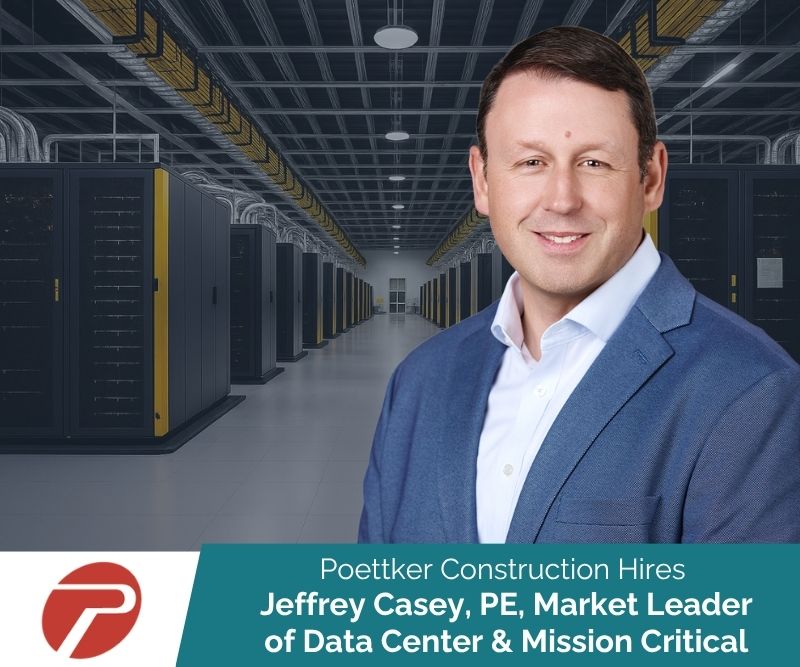
Insights from Jeff Casey, Market Leader, Data Center & Mission Critical, Poettker Construction
As demand for digital infrastructure accelerates, data centers are drawing increased attention from clients, communities, and policymakers, with conversations often focused on power, water, and land use (AFCOM).
At Poettker Construction, our role is to help translate those concerns into constructible, real-world solutions. That starts with grounding decisions in data and understanding how these facilities are planned, delivered, and integrated into the communities they serve.
1. Power Infrastructure: A Challenge That Shapes Every Project
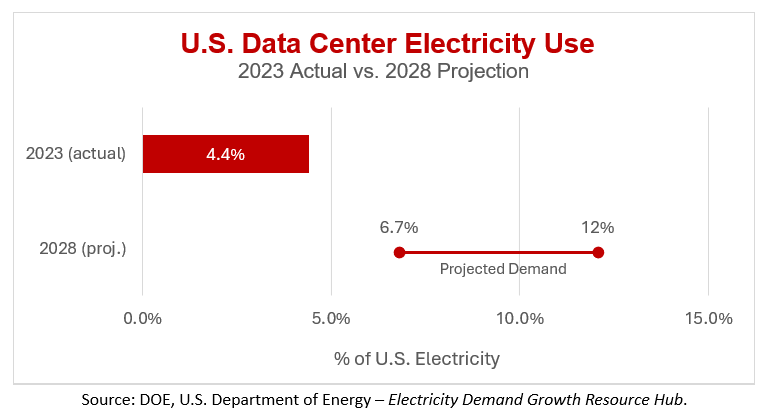
Power availability continues to be one of the most significant factors influencing data center development today. According to the U.S. Department of Energy, data centers consumed approximately 4.4% of total U.S. electricity in 2023, with projections reaching 6.7% to 12% by 2028 (DOE). At the same time, demand for electricity is increasing across multiple sectors, including artificial intelligence, manufacturing, and broader electrification initiatives (DOE). The International Energy Agency (IEA) also notes that data centers are projected to account for only about one-tenth of global electricity demand growth through 2030, with industrial motors, air conditioning, and electric vehicles contributing even more to future demand growth (IEA). Data centers are a visible contributor to growing energy demand, but they are only one part of a much larger transformation occurring across the energy and technology landscape.
What This Means in Practice
Across the market, power is often the primary factor that determines whether a project can move forward, influencing schedule, cost, feasibility, and long-term infrastructure planning. As digital infrastructure continues to expand alongside these broader trends, conversations around power availability are occurring earlier and carrying greater weight during site selection and project development.
To reduce long-term delays tied to power and utility interconnection timelines, developers are securing power early or investing directly in on-site or dedicated generation and infrastructure strategies. For owners and developers, partnering with a design-build contractor equipped to handle both the facility construction and utility infrastructure can help streamline planning, reduce risk, and improve project delivery.
2. Water Strategy: Driven by Technology and Geography
Water use in data centers is primarily tied to cooling systems, which play a critical role in removing heat generated by servers and other IT equipment (EESI). Cooling approaches vary widely and may include traditional air cooling, evaporative systems, or liquid-based technologies, resulting in significant differences in water consumption depending on facility design, operating requirements, and local conditions (GeekWire). As computing density continues to increase, many operators are evaluating liquid cooling and advanced thermal management systems to improve heat-transfer efficiency and reduce reliance on more water-intensive cooling methods (Ambient Enterprises).
What This Means in Practice
Water use is not a one-size-fits-all consideration. Climate conditions, cooling system selection, and local infrastructure availability all influence how a facility is designed and operated. Conversations around cooling strategy are occurring earlier in the planning process and often involve close coordination between owners, designers, contractors, utilities, and local municipalities.
These early decisions can have a meaningful impact on long-term operating costs, sustainability objectives, and overall project feasibility. We are also seeing increased interest in water-efficient and water-reducing cooling technologies as owners evaluate solutions that align with both operational requirements and site-specific conditions. Water use is not a fixed outcome; it is a design and operational decision shaped by technology, geography, and project goals.
3. Site Selection: Infrastructure-Driven, Not Opportunistic
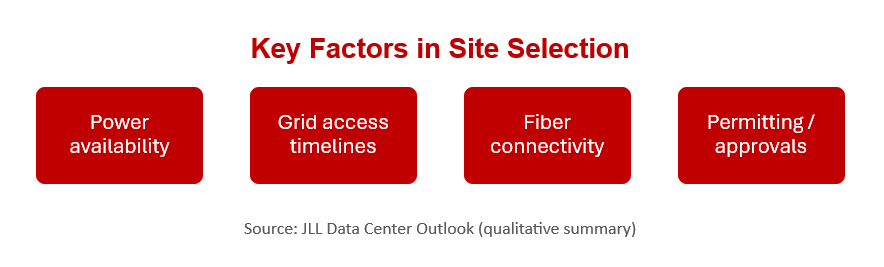
Data center site selection is increasingly driven by infrastructure availability rather than simply the amount of land available for development. According to JLL, power availability has emerged as one of the primary constraints influencing both site selection and overall project feasibility (JLL). At the same time, developers must evaluate factors such as grid access timelines, fiber connectivity, and regulatory and permitting requirements, all of which can significantly affect project schedules and long-term viability (JLL, Data Center Frontier). Data center development also frequently occurs in industrial corridors and brownfield redevelopment areas where critical infrastructure, utilities, and zoning are already in place, rather than on agricultural or undeveloped land (FAS).
What This Means in Practice
From a construction and development perspective, the pool of viable sites is often much narrower than it appears from the outside. While a parcel may seem attractive based on size or location alone, factors such as utility capacity, permitting requirements, fiber connectivity, and overall site readiness play key roles in determining the best location for a data center.
As a result, many projects are concentrated in established industrial corridors or brownfield sites where key infrastructure is already available or can be expanded more efficiently. This means site selection is often less about finding available land and more about identifying locations that can realistically support a project’s power, connectivity, utility, and schedule requirements. Infrastructure readiness and regulatory feasibility remain among the most important factors shaping where data centers are built.
4. Community Integration: Measured Through Long-Term Impact
Data centers continue to play an important role in supporting the digital infrastructure that drives modern business, communication, and technology services. According to the Data Center Coalition, the U.S. data center industry supported a 17% increase in employment, approximately 5.5 million jobs in 2024, while contributing significantly to GDP and tax revenue (PwC 2026). In addition, each direct data center job supports more than 4.5 additional jobs across the broader economy (PwC 2026). As demand for digital services continues to grow, data center development remains closely tied to long-term economic growth and infrastructure investment (PwC 2026).
What This Means in Practice
From a project delivery perspective, the most immediate community impact occurs during planning and construction. Data center projects often involve multi-year construction schedules, coordination with local municipalities and utilities, and opportunities for local subcontractor and workforce participation.
As projects move from planning into execution, early communication and coordination become increasingly important. Owners, municipalities, utilities, and construction teams must work together to align infrastructure needs, schedules, and project requirements. Over the long term, these projects often contribute to local tax bases, infrastructure improvements, and workforce development initiatives, making it important to evaluate community impact across the full building lifecycle rather than solely during construction.
5. Growth Drivers: A Broader Digital Transformation
Demand for data center development continues to be driven by a range of factors across the digital economy. According to JLL, AI represented approximately 25% of data center workloads in 2025, with continued growth expected (Data Center Frontier). At the same time, data center expansion is being fueled by broader trends, including cloud computing adoption, increased enterprise data usage, and the continued growth of distributed computing and edge applications (JLL). Taken together, these factors point to a long-term infrastructure expansion cycle tied to digital services, connectivity, and the growing demand for data processing and storage (JLL).
What This Means in Practice
Project demand is driven by a diverse set of factors rather than a single technology trend, with AI accelerating part of that demand. Owners and developers monitor and plan for industry needs as growth in cloud services, enterprise computing, and distributed infrastructure continues.
As a result, we’re seeing continued investment in a variety of data center facilities and infrastructure located closer to end users. For contractors and project teams, this reinforces the importance of long-term planning and scalable infrastructure strategies that can support evolving shift toward a digital-first economy.
Conclusion: From Perception to Practical Decision-Making
Data centers depend on power, water, land, and coordination, but understanding how those elements come together is critical to making informed decisions.
At Poettker, we focus on:
- Early coordination and constructability
- Transparent communication with stakeholders
- Aligning infrastructure investment with long-term community outcomes
The most effective conversations move beyond assumptions and focus on data, context, and execution.
To learn more about our approach to data center development, visit our Data Center & Mission Critical webpage or connect with Jeff Casey, Market Leader, Data Center & Mission Critical, to discuss any site feasibility or project planning questions.
Sources
- AFCOM – A Fact-Based Guide to 5 Top Data Center Concerns. May 15, 2026. https://afcom.com/news/726778/WHITEPAPER–A-Fact-Based-Guide-to-5-Top-Data-Center-Concerns.htm
- DOE, U.S. Department of Energy – Electricity Demand Growth Resource Hub. December 20, 2024. https://www.energy.gov/policy/electricity-demand-growth-resource-hub
- International Energy Agency (IEA) – Energy and AI. 2025. https://www.iea.org/reports/energy-and-ai
- EESI, Energy Efficiency & Sustainability Initiative – Data Centers and Water Consumption. 2025. https://www.eesi.org/articles/view/data-centers-and-water-consumption
- GeekWire – As Data Center Demand Soars, Amazon Expands Use of Wastewater to Cool its Cloud. 2025. https://www.geekwire.com/2025/as-data-center-demand-soars-amazon-expands-use-of-wastewater-to-cool-its-cloud/
- Ambient Enterprises – A Guide to Data Center Liquid Cooling. November 18, 2025. https://ambient-enterprises.com/news-insights/a-guide-to-data-center-liquid-cooling/
- Data Center Frontier – JLL’s 2026 Global Data Center Outlook: Navigating the AI Supercycle, Power Scarcity and Structural Market Transformation. 2026. https://www.datacenterfrontier.com/cloud/article/55341273/jlls-2026-global-data-center-outlook-navigating-the-ai-supercycle-power-scarcity-and-structural-market-transformation
- JLL – 2026 Global Data Center Outlook. 2026. https://www.jll.com/en-us/insights/market-outlook/data-center-outlook
- FAS – Transform Communities by Adaptive Reuse of Legacy Coal Infrastructure to Support AI Data Centers. 2025. https://fas.org/publication/adaptive-reuse-legacy-coal-infrastructure/
- PwC 2026 – Economic Contributions of U.S. Data Centers. 2026. https://www.centerofyourdigitalworld.org/2026-impact-study