Publication: Constructor Magazine, May/June 2026
On most construction sites, risk often hides in blind spots — on rooftops, behind façades, and within small misalignments that lead to costly rework or litigation. Contractors are increasingly turning to drones, not as a marketing tool, but as a component of their risk management strategy to reshape how projects are documented, monitored, and protected. Aside from capturing images, drones can also generate defensible data, reduce exposure, and provide visibility that traditional methods cannot match.
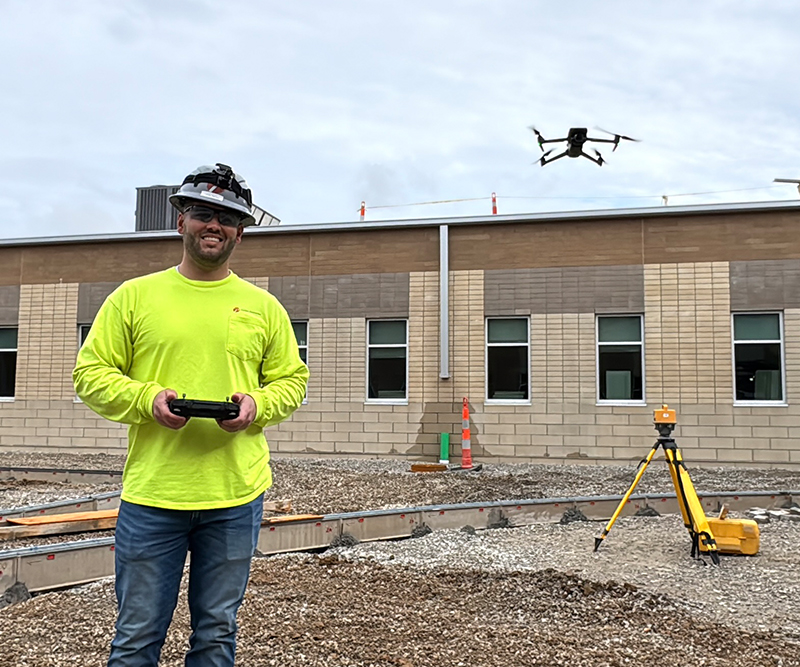
For many firms, the shift is deliberate. Poettker Construction’s drone program sits squarely within its risk management department.
“Poettker’s drone program lives in our risk management department because its primary function is to to support our people and construction operations to drive safer and higher quality outcomes,” said Charles Wilson, vice president of risk management at Poettker, a member of multiple AGC chapters. “Given the increased demand for drone flights for safety, quality, and production needs, it made financial sense to invest in our own drone program.”
Data Collection
Drones generate measurable, timestamped, and verifiable data that can stand up in disputes, audits, and claims. Contractors using drones rely on 2D maps, 3D models, and geospatially accurate imagery to create precise project conditions. These datasets allow teams to quantify earthwork, verify installations, and compare progress against design without stepping foot in a hazardous area. Traditional inspections often require ladders, lifts, or scaffolding. Drones offer a safer alternative and allow teams to capture detailed data without putting people in harm’s way. In addition, drones give access to remote stakeholders who are not on-site every day but can sometimes hold up decision-making processes if they cannot see the reality on site.
“The amount of data collected in a short flight surpasses the amount that a person inspecting an installation can provide on their own,” said Wilson. “Anytime we can eliminate the need for a person to work at an elevated position is a win.”
Beyond safety, contractors can also document site conditions daily, creating a record that can resolve disputes before they escalate. Matt Daly, CMO for DroneDeploy, an AGC of California and TEXO member, has hundreds of stories from contractors who have saved money because of their drone programs.
“Giving contractors one source of truth for what is happening on site is massively useful,” said Daly. “One contractor avoided a $250,000 delay claim by using drone imagery to prove materials were on site when claimed, invalidating allegations. Another contractor had a $45,000 backcharge withdrawn because aerial overlays proved that a driveway slab matched the plan.”
By providing high-frequency, sitewide visibility, drones enable remote owners, engineers, and inspectors to verify progress, assess conditions, and make faster decisions. This reduces information delays. In addition, consistent aerial data can help teams identify issues before they become costly problems.
FAA Regulations and Airspace
Construction drone operations are governed by the Federal Aviation Administration (FAA), and compliance is a critical component of risk management. At a minimum, commercial drone operators must hold a Part 107 Remote Pilot Certificate by passing an FAA knowledge exam and staying current with ongoing training.
Airspace considerations can also add some complexity. Projects located near airports or in controlled airspace require
advance authorization through systems like LAANC (Low Altitude Authorization and Notification Capability). However, many drone platforms include built-in airspace awareness tools that alert operators to restrictions and facilitate authorization requests.
The regulatory landscape continues to evolve, especially with the FAA’s proposed Part 108 rule on beyond visual line of sight (BVLOS) operations. The proposed framework, outlined in a 2025 Federal Register notice, aims to normalize routine BVLOS flights by establishing requirements for detect-and-avoid systems, airspace coordination, and operational oversight. For construction, BVLOS restrictions are one of the biggest barriers to drone operations, so easing limitations could allow drones to cover larger sites more efficiently and enable automated, scheduled data capture.
“The FAA’s proposed Part 108 rule is a big deal because it would move drone flights beyond one-off approvals and into a clear, nationwide set of rules that allows companies to fly drones BVLOS on a regular basis,” said Logan Decker, Poettker’s drone operator. “Instead of needing special waivers each time, operators would have a consistent path to run larger, more efficient drone programs that can cover much bigger geographic areas per flight. This shift would reduce time and labor costs and unlock high-value use cases.”
Insurance: Coverage, Requirements, and Opportunities
While drone insurance is not mandated by the FAA, it is not optional in practice. Many project owners require contractors to carry specific liability coverage for drone operations, often through preauthorization requirements. Coverage structures can vary with some policies tied to individual operators and others that cover broader organizational use.
On the upside, drones can offer a path to reduced insurance costs over time. By improving documentation, reducing accidents, and enabling early issue detection, drones can lower the frequency and severity of claims.
Data Ownership and Security
As drones generate more sophisticated data, questions around ownership and control are becoming more prominent. In most cases, data ownership is defined by contract. Owners may require access to all documentation, while contractors may retain rights to use the data for internal purposes. Third-party providers may use anonymous data to improve their services, but they typically do not claim ownership or share project data externally without permission.
Security is equally critical. With sensitive project information at stake, providers are investing in certifications, access controls, and data governance protocols to ensure that only authorized users can access information.
Policy, Procurement, and Geopolitical Risk
Beyond project-level considerations, broader policy shifts also shape the drone landscape. Federal scrutiny of foreign-made drones, for example, has introduced new considerations around procurement and cybersecurity. In December, President Trump banned the sale of new foreign-manufactured drones amid growing concerns surrounding data security and supply chain integrity. However, the FCC recently exempted some of those models. For contractors, it is important to stay up to date with changing policies to ensure they maintain compliance since these policies can influence equipment selection and vendor relationships.
Less Adoption Challenges
Some contractors remain hesitant to adopt drone technology because of perceived complexity, regulatory hurdles, and safety risks. However, many of these barriers are diminishing. Contractors can choose to build in-house drone programs or use third-party providers who handle compliance, data capture, and processing. Training resources are widely available, and the technology itself has become more reliable and user-friendly.
“The biggest challenge with launching a drone program is getting employees to adjust to conducting safety inspections and other protocols in a new way,” said Decker. “Forming new habits takes time. Once our team experienced the advantages of the drone program, flight requests dramatically increased.”
Automation and AI
Looking ahead, the next phase of drone-enabled risk management is already taking shape.
Automated “drone-in-a-box” systems can capture data on a schedule without human intervention, ensuring consistent documentation throughout the project. At the same time, artificial intelligence is transforming how that data is analyzed. AI-powered tools can now identify safety hazards, track progress, and compare conditions against schedules and design models in real time.
“We’ve only just begun integrating drones’ asset capture with AI’s safety monitoring,” said Wilson. “It is possible someday AI will use drone imagery to predict and prevent accidents from occurring.”
A New Standard of Care
As regulatory frameworks evolve, technologies mature, and usage expands, drones are becoming more than a competitive advantage — they are becoming a standard of care.
Having eyes in the sky may be one of the most effective ways to keep risk under control.
“Construction firms that haven’t adopted drones should explore the technology. The potential is significant: safer jobsites, stronger quality control, more accurate estimating, and smoother operations that can drive savings and set them apart competitively,” said Wilson.